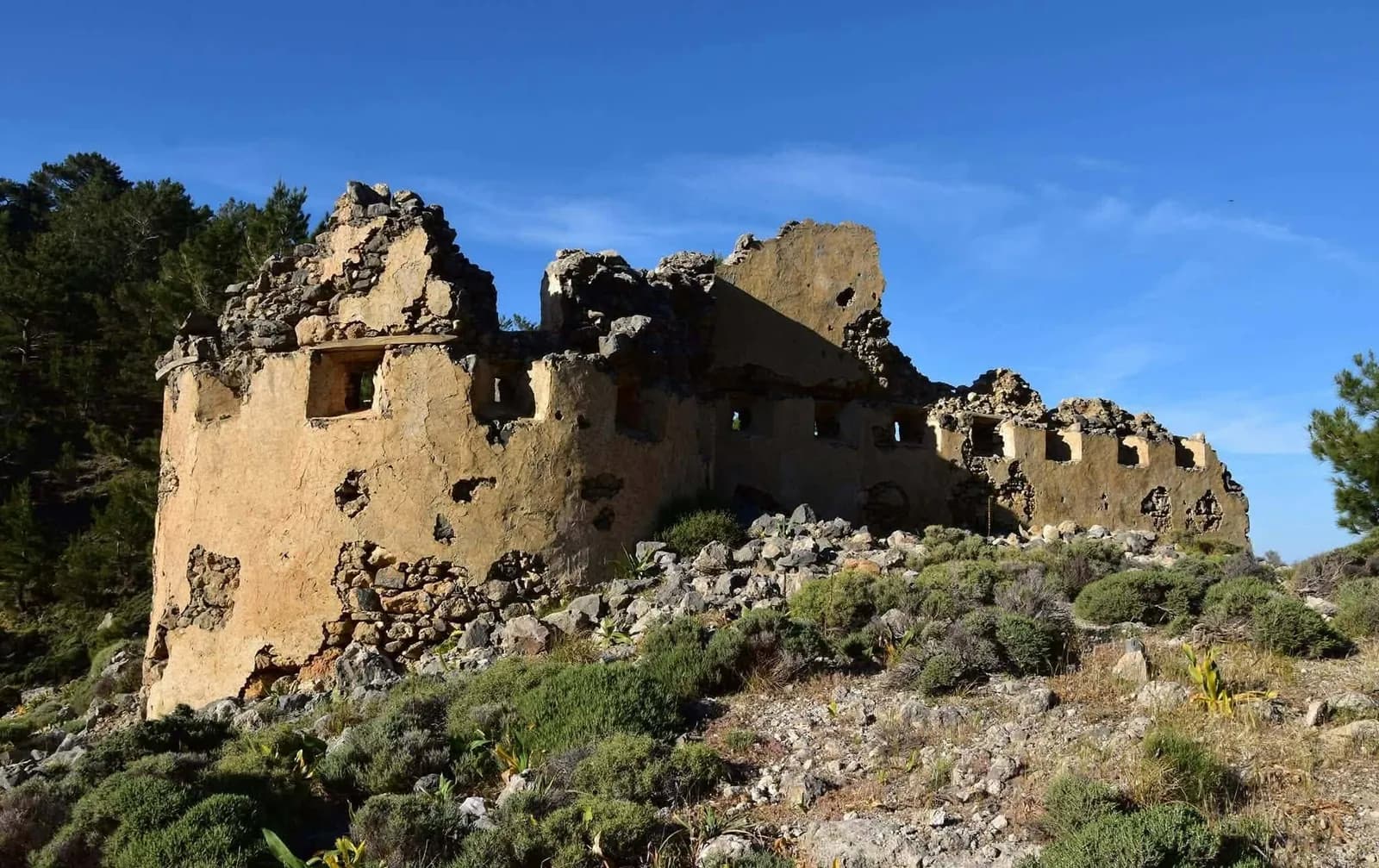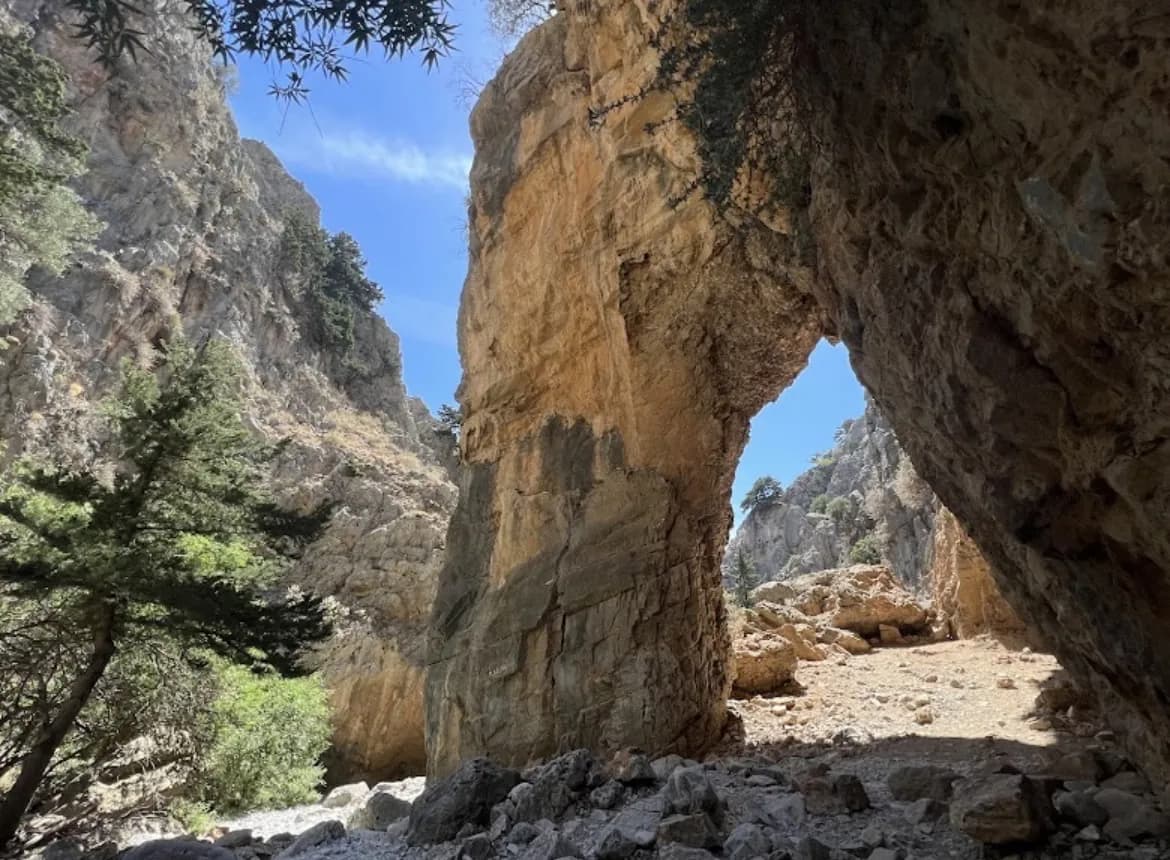
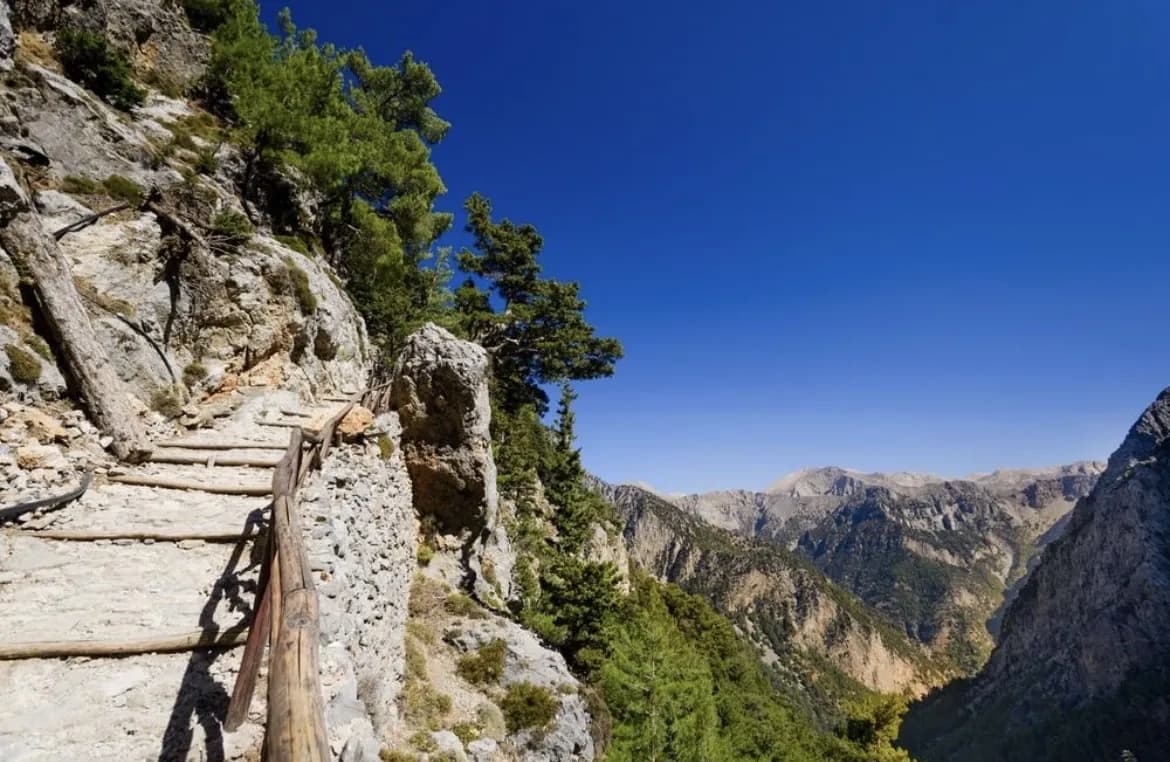
Most people walk through the Samaria Gorge for the cliffs, the pines and the famous narrow "Gates". About halfway down, the valley widens and you reach a group of stone houses in the shade of tall trees. This is the old village of Samaria. Nobody has lived here for decades, yet it is the place that gave the whole gorge its name.
A name from a church
Close to the village stands the small church of Osia Maria, dedicated to Saint Mary of Egypt. It is a modest stone building from the Venetian period, with old wall paintings inside. In local speech "Osia Maria" was shortened to "Sia Maria", and over time this became "Samaria". So the gorge, the village and today's national park all carry the name of this little church.
Life in the gorge
For centuries a small community lived here, cut off from the rest of the island. There was no road. The only ways in and out were the mule paths down from the Omalos plateau or up from Agia Roumeli on the south coast.
The families were mostly shepherds. They kept goats and sheep, grew what they could on small terraced fields, kept bees and gathered wood from the cypress and pine forests around them. Summers could be busy, with flocks moving up and down the mountains. Winters were long and hard, with flash floods in the riverbed and snow on the peaks above.
The isolation also made the gorge a refuge. During the Cretan revolts against Ottoman rule, rebels and their families took shelter in these mountains, where it was very difficult for any army to follow.
Why the villagers left
In 1962 the Samaria Gorge was declared a national park. One of the main aims was to protect the forest and the kri-kri, the wild Cretan goat, whose numbers had fallen dangerously low. Grazing, hunting and woodcutting were incompatible with that goal, so the families of Samaria had to move out. They were resettled outside the gorge, and the village was left to the park.
For the families it was a painful break with a way of life that had lasted for generations. For the gorge, it marked the start of a long recovery. Today the forest is thick again and kri-kri are often seen near the paths, sometimes right beside the old houses.
The village today
Some of the houses have been restored and serve the park as a rest stop, with toilets, drinking water, benches in the shade and a post for the park wardens. Many hikers stop here for a break before tackling the second half of the walk. Take a few minutes to look around: the stone walls, the old houses and the church of Osia Maria are what remain of a whole community.
Good to know
- Samaria village is roughly halfway through the gorge, a natural place to rest and refill water.
- Please keep your distance from the kri-kri and do not feed them.
- Show respect in the church: quiet voices and covered shoulders.
Walk the gorge with Crete it!
On our guided Samaria Gorge hike we stop at the old village, pass by Osia Maria and tell the story of the people who once lived here, before continuing through the Gates to the sea at Agia Roumeli.