Of all the myths set on Crete, none is better known than the tale of the Minotaur, half man and half bull, shut away in a maze beneath the palace of King Minos. It is a story of pride, clever inventions, love and betrayal.
A king, a bull and a labyrinth
In the myth, Minos asked the sea god Poseidon for a sign that he was the rightful king of Crete. Poseidon sent a magnificent white bull out of the sea, on the understanding that Minos would sacrifice it. Minos liked the bull too much and sacrificed another in its place.
Poseidon took his revenge. He made Pasiphae, the wife of Minos, fall in love with the bull. She turned to Daedalus, the brilliant craftsman of the court, who built her a hollow wooden cow. From this strange union the Minotaur was born, a creature with the body of a man and the head of a bull.
Minos could not let the monster roam free, so he asked Daedalus to build a prison for it. Daedalus designed the Labyrinth, a building with so many winding passages that anyone who entered could never find the way out. The Minotaur lived at its heart.
Minos then demanded a cruel tribute from Athens, as punishment for the death of his son there. At regular intervals the Athenians had to send seven young men and seven young women to Crete. They were sent into the Labyrinth and none came back.
Theseus, Ariadne and Icarus
Theseus, son of King Aegeus of Athens, chose to go with the young victims and put an end to the tribute. In Crete, Ariadne, the daughter of Minos, fell in love with him. She gave him a ball of thread. Theseus tied one end at the entrance, unwound it as he went in, killed the Minotaur and followed the thread back out.
The happy ending did not last. Theseus sailed away with Ariadne but left her on the island of Naxos, where in most versions the god Dionysus found her and made her his wife. Theseus also forgot to change his black sails to white as he had promised his father. Aegeus saw the black sails, believed his son was dead and threw himself into the sea, which, as the story goes, has been called the Aegean ever since.
Back in Crete, Minos blamed Daedalus for helping the Athenians and locked him up with his young son Icarus. Daedalus made two pairs of wings from feathers and wax. He warned Icarus to fly neither too low, near the sea spray, nor too high, near the sun. Icarus, thrilled, climbed too high. The wax melted, the feathers fell away and he dropped into the sea.
Myth and the palace of Knossos
When Arthur Evans excavated Knossos in the early 20th century, he found a vast complex of rooms, corridors, stairways and courtyards on several levels. It is easy to imagine how such a building, seen in ruins by later Greeks, could have inspired the idea of a labyrinth. Bulls were also central to Minoan art and ritual, from the famous bull-leaping fresco to stone bull horns used as sacred symbols. Some scholars link the word "labyrinth" to the labrys, the double axe that often appears in Minoan religion. These are attractive theories. They remain theories, and the myth itself is a much later Greek story about a Crete of the distant past.
Walk a winding labyrinth of stone
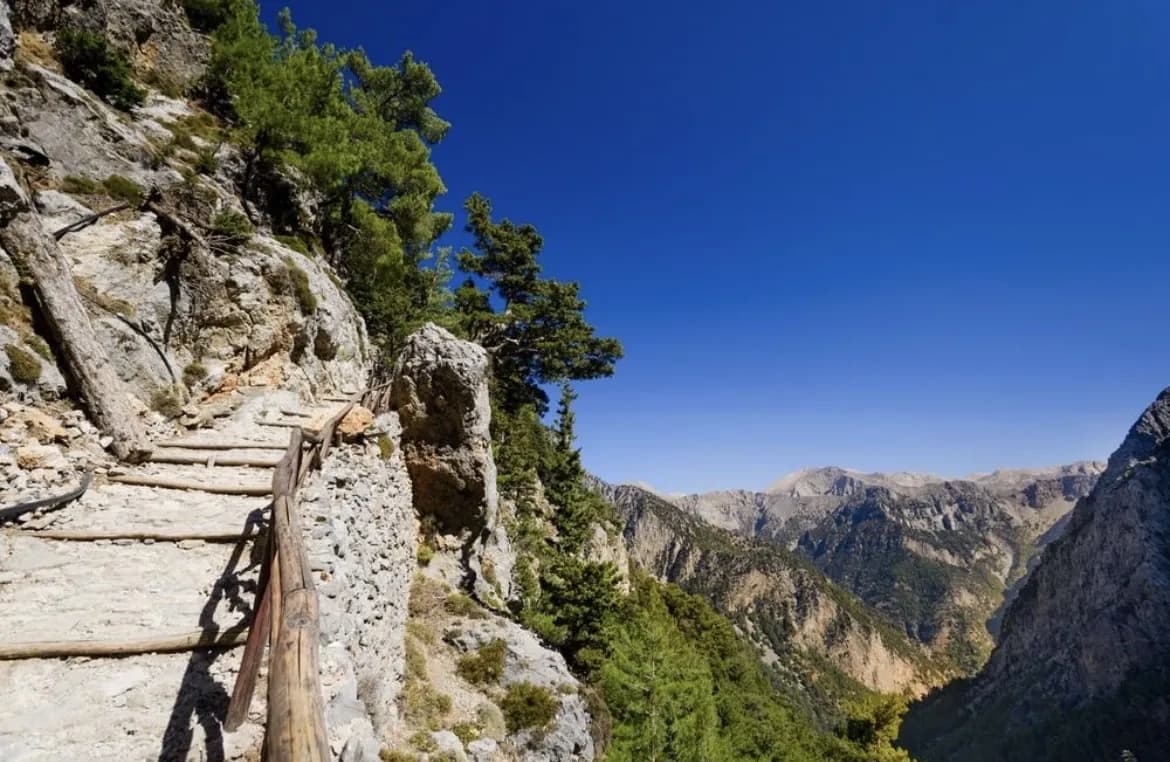
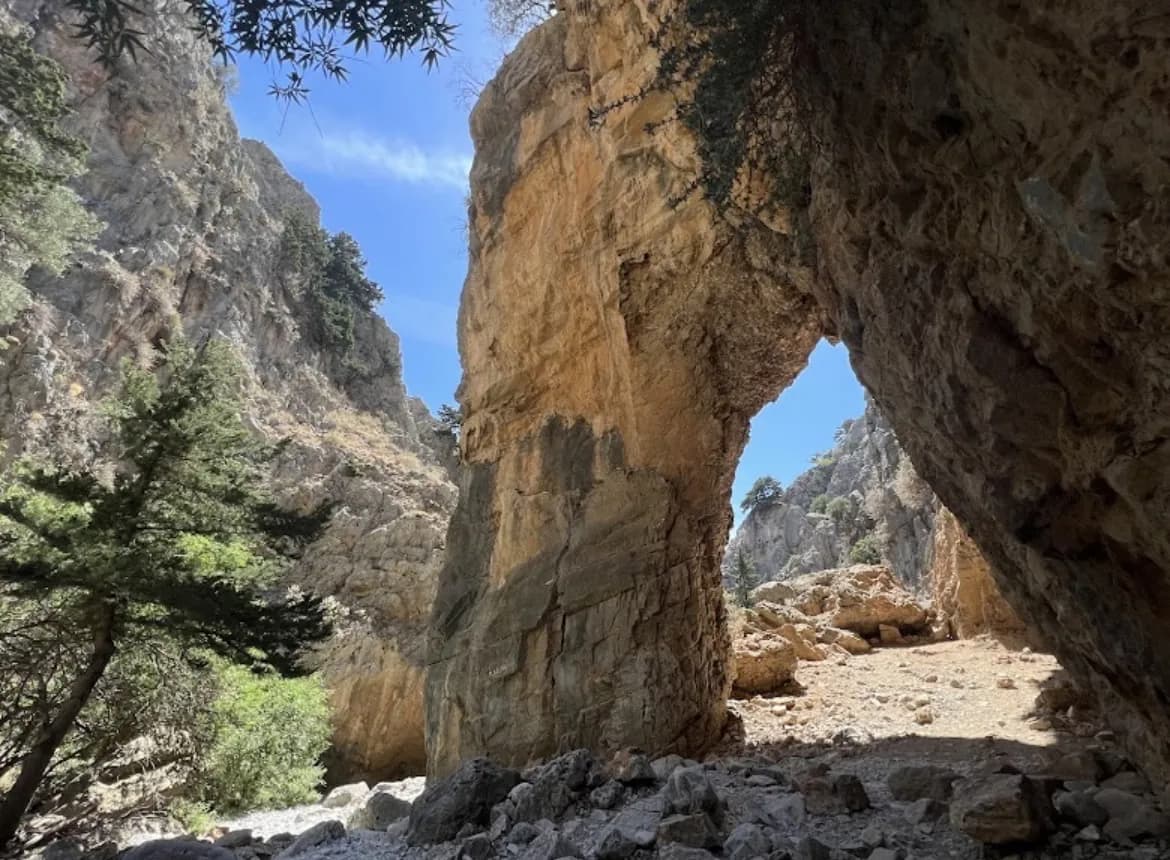
Crete still has its own natural mazes. Imbros Gorge twists for about 8 km between high limestone walls, narrowing in places to a couple of metres and passing a striking natural rock arch. No thread is needed, since the path is clear and our guides know every bend. Join us and walk through one of the island's most beautiful corridors of rock.