Drive through Apokoronas and you will see olive trees almost everywhere: on terraces above the villages, along dry riverbeds, between the houses. In Crete the olive is more than a crop. It is part of the landscape, the kitchen and family life, and it has been for a very long time.
A Minoan inheritance
People on Crete were already using olives in the Bronze Age. Archaeologists have found olive pits, oil lamps and large storage jars called pithoi at Minoan sites. At Knossos, long rows of these jars stood in the palace storerooms. Clay tablets written in Linear B list olive oil among the goods the palace recorded. Oil was food, but it was also fuel for lamps, a base for perfumes and a valuable product for trade across the Aegean.
Trees older than memory
Olive trees can live for many centuries, and Crete has some remarkable ones. The best known is the olive tree of Vouves, in the west of the Chania region. Its trunk is huge and twisted, and it still bears fruit. Estimates of its age vary widely, but it is generally thought to be well over two thousand years old. Many other villages have their own old giants, often protected as monumental trees, with trunks so wide that it takes several people to circle them.
The most common variety on the island today is Koroneiki, a small olive that gives an aromatic, fruity oil. In western Crete you will also find older local varieties such as Tsounati.
From the tree to the mill
The harvest runs roughly from November to January, depending on the area, the weather and how ripe the fruit is. Families spread nets under the trees and knock or comb the olives down, today often with handheld electric harvesters. The olives go into sacks and are taken to the mill quickly, ideally within a day or so, because fresh fruit makes better oil. For many Cretan families it is a time when relatives come home to help, and long days in the groves end with food and wine.
A modern mill is clean, fast and mostly made of stainless steel. The basic steps are simple:
- The olives are separated from leaves and twigs, then washed.
- They are crushed, stones and all, into a thick paste.
- The paste is mixed slowly for a while, which helps tiny drops of oil join together. When this is done at a low temperature, the oil can be described as cold extracted.
- A centrifuge separates the oil from the water and the solids.
- The oil is left to settle or filtered, then stored away from light and heat.
Fresh oil straight from the mill is often cloudy and bright green, with a bitter, peppery bite at the back of the throat. That bite is a sign of fresh oil from healthy, recently picked fruit.
Oil at the Cretan table
Olive oil is the main fat in traditional Cretan cooking. It goes into salads, vegetables, beans, pies and nearly every everyday dish. In the mid-20th century Crete was one of the regions included in the Seven Countries Study, research that helped bring the Mediterranean diet to international attention. Today the traditional Cretan way of eating, rich in vegetables, pulses, herbs and olive oil, is widely seen as a classic example of that diet.
Taste it in Apokoronas
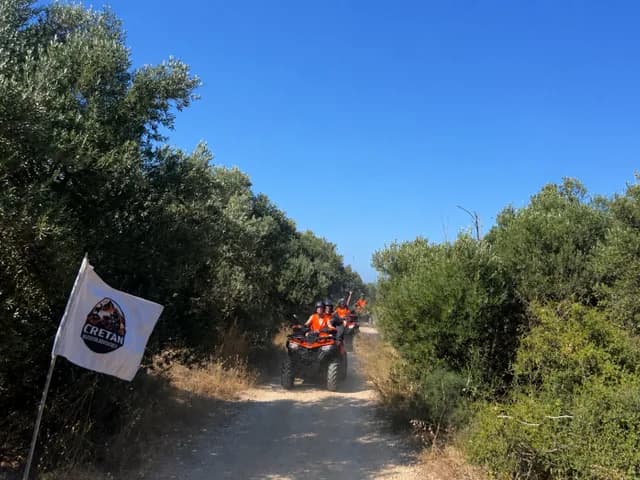
Apokoronas is olive country, with groves climbing from the coast toward the foothills of the White Mountains. On our Quad Safari through the secret villages you ride along trails between the trees, visit a local olive oil mill and taste different varieties side by side. It is the simplest way to see how a Cretan olive becomes the oil on your plate.